Gemstone Lights vs. JellyFish Lighting: An Honest Comparison for Omaha Homes (2026)
Fair warning before you read a word of this: we're an installer, and what we install is Forever Lighting. We don't sell Gemstone and we don't sell JellyFish. Read everything below with that thumb on the scale. We're writing it anyway because this is one of the most common questions we get from homeowners in Elkhorn, Papillion and west Omaha — usually at the end of an evening spent comparing spec sheets that were each written by a dealer for the brand they happen to sell. An honest side-by-side is genuinely hard to find. Here's our attempt at one.
What do Gemstone and JellyFish have in common?
More than either brand's marketing would like to admit. Both are permanent systems: individually addressable LED nodes fixed along your fascia, wired back to a controller, driven from an app. Both offer millions of colors, scheduling, zones, and the pattern effects everyone plays with for the first month — chases, fades, twinkles. Both are sold and installed through regional dealer networks rather than a local factory. Both will look genuinely beautiful in a night photo.
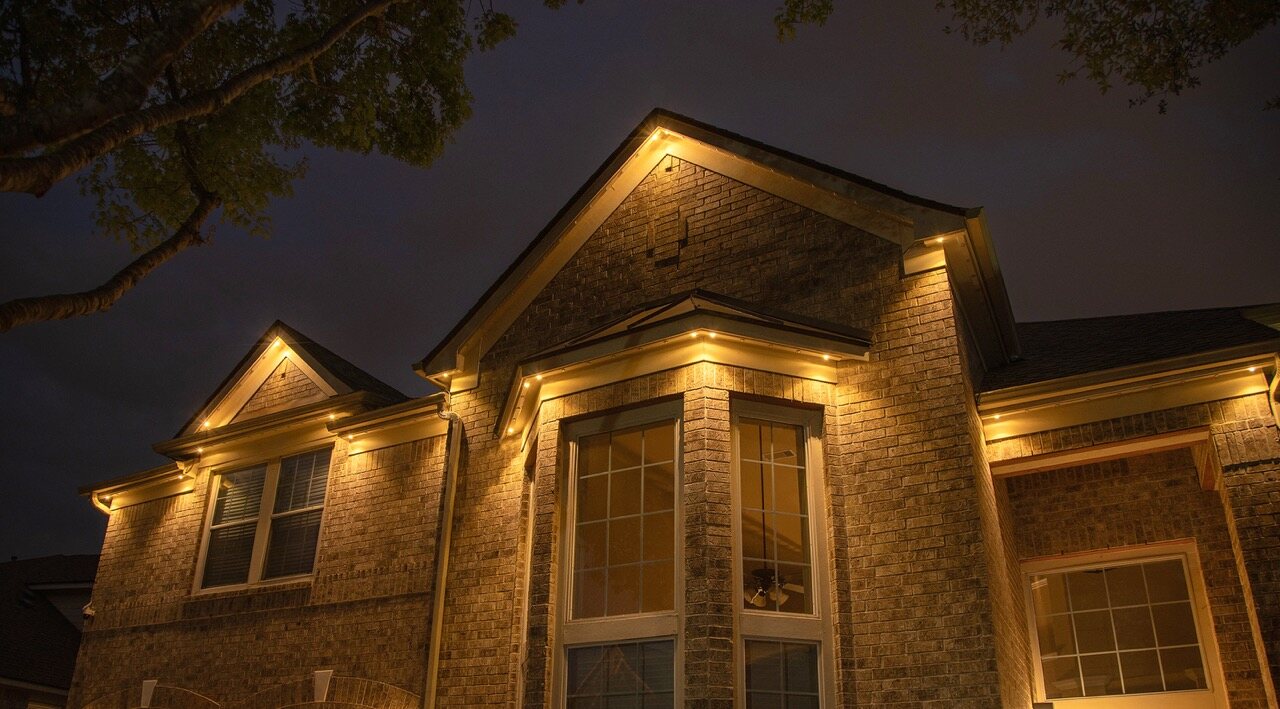
That last point deserves more weight than it usually gets. Every permanent lighting brand looks spectacular after dark. That's the entire product category doing its job. It also means the night photos filling both brands' galleries are close to useless as a decision tool — they're testing the LEDs, and the LEDs are not where these systems differ. We walked the full category, Trimlight and Oelo included, in our brand-by-brand comparison, and reached the same place.
What actually separates the two?
The daytime look, which is really a question about the channel. This is the difference worth caring about. Gemstone's pitch has always centred on a trim-integrated profile — the track is meant to be finished to your fascia color so that at noon in July it reads as part of the house's trim rather than as a lighting product bolted onto it. JellyFish takes the tuck-away approach: a slim channel seated under the roofline, designed to go unnoticed from the street. Both are aiming at the same goal — invisible by day — from slightly different angles.
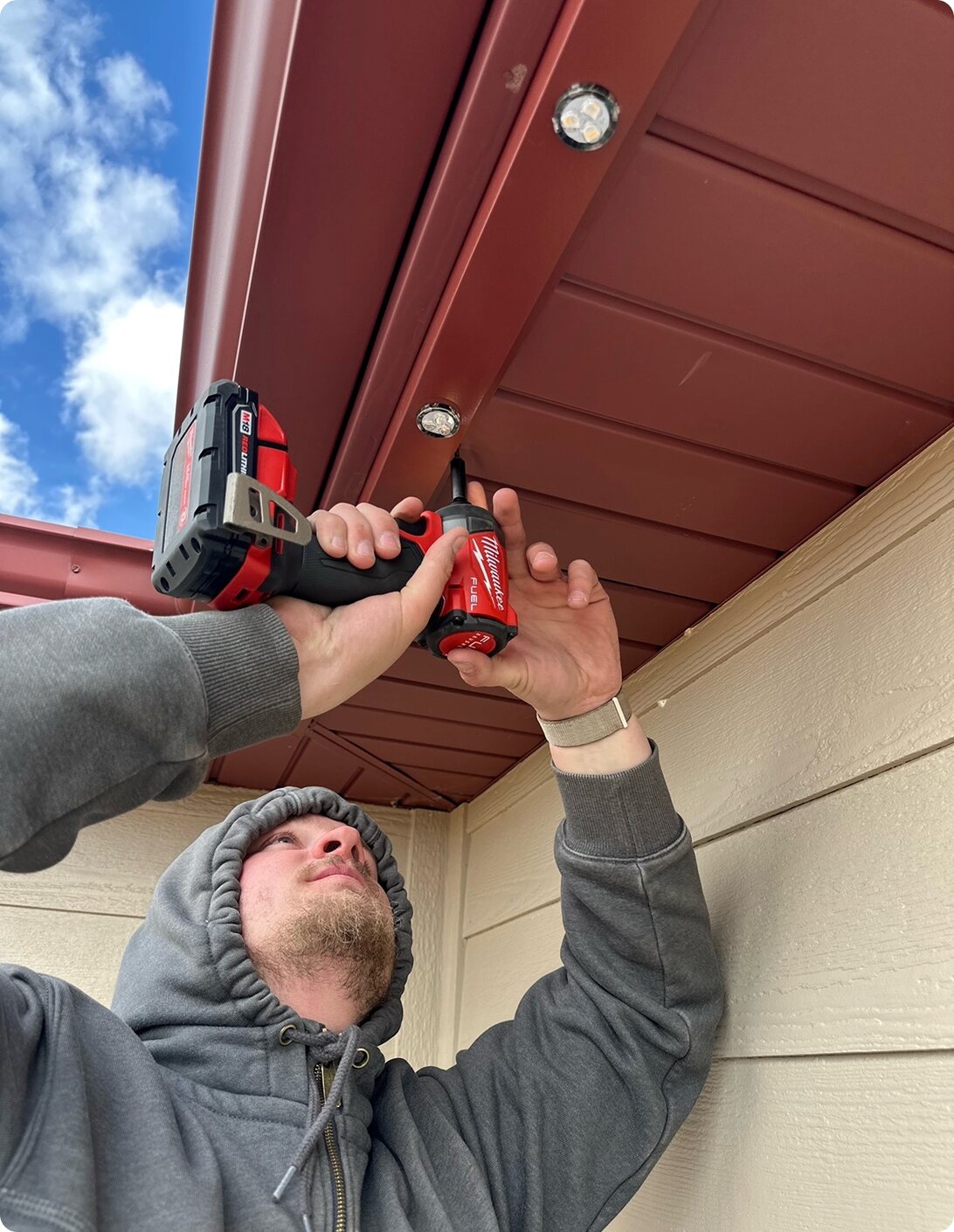
Here's the part neither brochure says out loud: whether that goal is actually reached on your house is mostly an installation outcome, not a brand outcome. A perfectly matched channel installed with a wave in it across a forty-foot eave looks worse than a plainer channel installed dead straight. We've been called out to look at both. Color match and line are the two things that decide whether a permanent system disappears in daylight, and both belong to the crew on the ladder.
How you buy it. Both brands route through dealers, which sounds identical but isn't in practice. Dealer territories change hands. The person who quotes you may not be the person who returns in year three — that's true for either brand, and it's the single most useful question you can ask about either.
What do Gemstone and JellyFish cost in the Omaha metro?
Treat every per-foot figure you find online with suspicion. Almost all published Gemstone and JellyFish pricing comes from a dealer blog comparing itself favorably to a rival, and the real numbers swing hard by market, by roofline length, and by how many corners and peaks your home has. Rather than repeat figures we can't stand behind, here's the one we can: professionally installed permanent lighting in the Omaha metro generally starts around $5,000 and scales from there with complexity. Forever Lighting through Glow Getter starts at $5,000, with financing available. Our permanent lighting cost guide breaks down what actually moves a quote, and the pricing page sets permanent next to seasonal installs if you're still weighing the two approaches.
Whichever brand you're quoting, insist on a measured number for your roofline before you compare anything to anything. A per-foot rate without a design behind it is a guess wearing a decimal point.
So which should an Omaha homeowner choose?
Here's the checklist we'd hand a neighbor, and it works no matter whose logo ends up on the controller:
- Go see a local install in daylight. Not at night — at noon. Daylight is the only condition where a trim channel either vanishes into the fascia or announces itself from the curb, and it's the whole reason to prefer one system over another. Any installer proud of their work has an address to show you.
- Ask who picks up the phone in year three. This is a decade-long fixture on your house. A brand reached through a dealer who may or may not still hold the territory is a materially different service proposition than a local crew you can call. The brochures never answer this one.
- Ask for a rendering of your own home before you sign anything. Which rooflines get lit — and which ones deliberately don't — shapes your result more than any brand decision on this page. You should be approving a picture of your house, not a promise about someone else's.
If a Gemstone or JellyFish dealer wins on those three for your home, that's a good outcome and we mean it. We simply like where we stand: Forever Lighting is engineered by Holiday Bright Lights, headquartered right here in Omaha, with true tunable whites from 2700K candlelight to a crisp 5000K, LEDs rated past 50,000 hours, and roughly 80% less energy than a traditional display. It's designed to your house, installed by Luke's insured crew, and backed by a 5.0 on Google. If you want the other head-to-heads, we've written JellyFish vs. Forever Lighting and EverLights vs. JellyFish too.
From Elkhorn to Council Bluffs, any of these systems will make your house glow in December. The difference shows up in March, in year three, and in who drives out when a section goes dark. Choose for that.
See your roofline in sixteen million colors — before you commit
Request a free custom design rendering of your home with Forever Lighting, plus an exact quote. No pressure, no brand bingo.
Or call/text 531-999-6388
We do the work. You enjoy the wonder.