Permanent Lighting Design: Which Rooflines to Light (and Which to Skip)
- Light the silhouette first: outer eaves, main peaks, garage line.
- Interior peaks and dormers are optional; decide from a rendering, not a guess.
- Design the front first, then add sides or the whole home where they are visible.
- Pick your everyday white carefully, since it runs far more nights than any color.
- Daytime looks come from track color-matching and clean corners, not the LED brand.
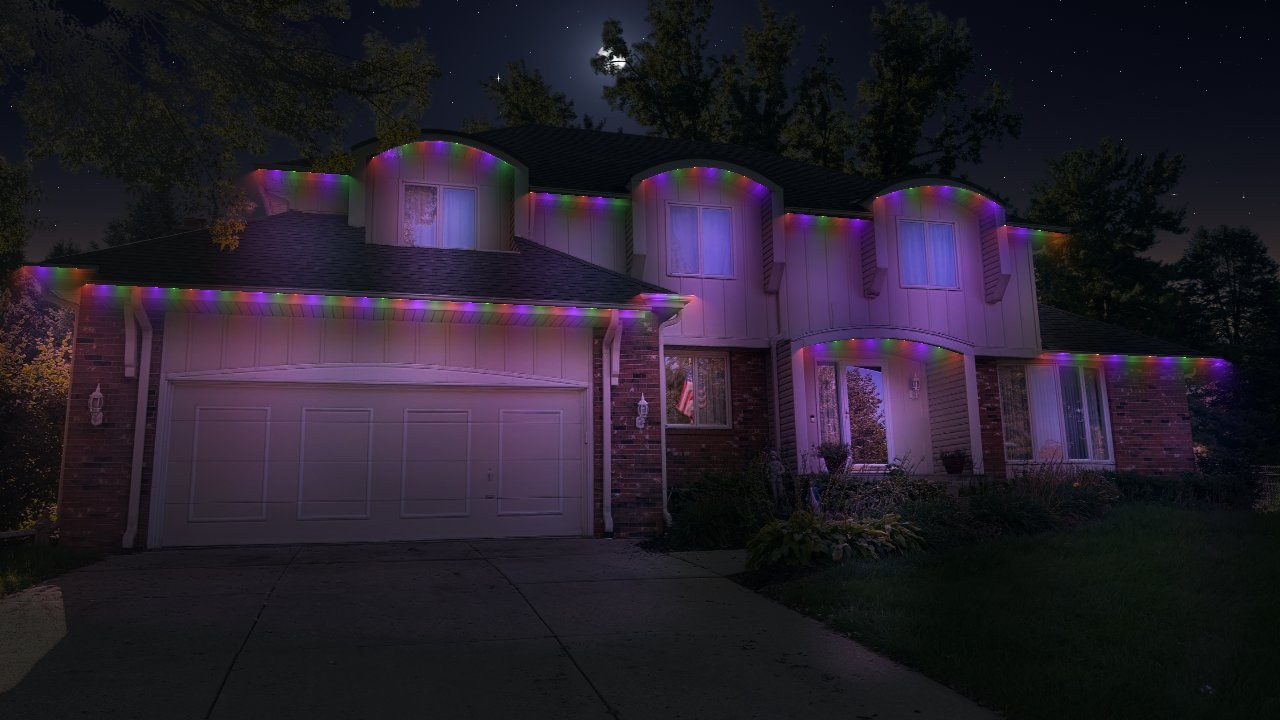
The most common mistake we see with permanent lighting is not a bad product. It is a design that lights everything. When every edge glows the same, a house loses its shape at night and starts to look like an outline drawing. Good permanent lighting does the opposite: it picks the lines that make your home look like itself and lets the rest stay quiet.
This guide walks through how we design permanent roofline lighting for Omaha homes, from the first look at the street to the last corner of track. Use it to plan your own home, or to judge any proposal you are comparing.
Start with the silhouette
Stand at the street at dusk and look at your home. The lines you notice first are usually the outer eaves, the tallest front gable and the long horizontal line over the garage. Those are your primary lines. On most Omaha homes, lighting them alone creates a crisp, finished frame that reads clearly from the road.
- Outer eaves: the continuous line that carries the eye across the front of the home.
- Main peaks: the gables that give the home its character. These are where light does the most work.
- Garage line: on two- and three-car garages, a long run that anchors the whole design.
A quick test: if you squint at a night photo and can still recognize your house, the primary lines are doing their job.
Decide on the secondary lines
Interior peaks, dormers, eyebrow eaves and lower roofs over the entry are optional. Sometimes they add depth; sometimes they add noise. The answer depends on your architecture:
| Feature | Usually light it when | Usually skip it when |
|---|---|---|
| Interior peak | It is large, centered and defines the entry | It is small or stacked close to a bigger peak |
| Dormers | They are evenly spaced and part of the home's style | They break up an otherwise clean eave line |
| Eyebrow eave returns | The home is symmetrical and the returns are prominent | They add many short corners with little visual payoff |
| Porch or entry roof | It frames the front door at eye level | It sits directly under a lit eave and doubles the line |
This is where a rendering earns its keep. We show the design with and without the optional lines so you can see the difference instead of guessing, and price each one so you can decide what is worth it.
Fronts first, then sides
Most homeowners start with the front of the home, which is what neighbors and guests see. Sides and the back can be added as options. They are often worth it on corner lots, homes with a visible side gable, walkouts with a lit backyard and lake lots. Because permanent systems are modular, you can also start with the front and add the sides later without replacing anything.
We always design the front as the base and show the sides and a whole-home option separately, so you decide what is worth lighting on your home rather than paying for runs nobody sees.
Pick the right white
Most nights, your permanent lights will be warm white, so the white matters more than any color. Systems with true tunable whites let you choose anywhere from a soft 2700K candlelight to a crisp 5000K.
| Home exterior | White we usually recommend |
|---|---|
| Red brick, stone, warm earth tones | 2700K to 3000K, warm and inviting |
| White, gray or modern farmhouse | 3000K to 3500K, clean without feeling cold |
| Contemporary, black trim | 3500K to 4000K for a sharper, architectural look |
Brightness matters too. Architectural lighting should glow, not glare. We set your everyday scene at a level that flatters the home from the street without lighting up the neighbor's bedroom.
Spacing, direction and corners
Three details separate a designed install from an ordinary one:
- Consistent spacing. Evenly spaced lights read as a clean line. Gaps at corners or bunching at peaks look accidental.
- Clean terminations. Every run should start and stop at a logical architectural point, not halfway across a gable.
- Sharp peaks. The light should meet precisely at the top of each gable. It is the first place the eye goes.
Make it disappear by day
Daytime looks are decided by the track, not the LEDs. A channel color-matched to your fascia or soffit, straight runs and tidy wiring make the system read as trim. A mismatched track on dark fascia is the first thing people notice, so we match it on every install. If you are comparing installers, ask to see a finished home at noon, not just at night. Our installer checklist has six more questions worth asking.
How design affects cost
Most front-of-home permanent lighting designs in Omaha start around $3,500 installed, and whole-home designs on larger homes often run $8,000 to $12,000 or more, with financing available. Price follows the design: more lit footage, more corners and taller elevations add material and labor. That is another reason to design deliberately. Skipping a busy secondary line often makes the home look better and costs less. For the full breakdown, see what permanent lighting costs in Omaha.
Our design process
- Measure. We measure every run from property records and photos, checked against known sizes like garage doors.
- Render. You see your actual home lit in warm white and in color, with optional lines shown separately.
- Refine. We adjust lines, whites and options together until it looks right to you.
- Install. Our own crew installs it, sets up your favorite holiday scenes and walks you through the app before we leave.
Anyone can sell you lights by the foot. What you are really buying is the decision about where they go. Curious about the mechanics? Here is how permanent roofline lights work, or see the system we install.
Frequently asked questions
Should I light every roofline on my house?
Usually not. Lighting the outer eaves, main peaks and garage line creates a cleaner design than lighting every edge. Interior peaks and short runs are optional and best decided from a rendering.
What color temperature should permanent lights be?
For brick, stone and warm exteriors, 2700K to 3000K. For white, gray or modern homes, 3000K to 4000K. Tunable systems let you adjust it any time.
Can I add the sides of my house later?
Yes. Permanent systems are modular, so many homeowners start with the front and add the sides or whole home later.
Do permanent lights look good during the day?
When the track is color-matched to your fascia and installed with clean corners, it reads as trim in daylight and is barely noticeable.
Does lighting fewer lines cost less?
Yes. Price follows lit footage, corners and height, so a focused design often looks better and costs less than lighting everything.
See your home lit before you decide
Get a free custom design of your home, warm white and full color, with a clear quote for the front, sides or whole home.
Or call/text 531-999-6388
We do the work. You enjoy the wonder.